
The Interregnum
Mapping the Monsters of the New World Disorder

The postwar order is dying, not with a bang, but with a cascade of exceptions. Treaties are selective, trade is weaponized, and power is exercised as leverage, not restraint. Sovereignty has become conditional, law advisory, and technology, the new frontier of dominion. We are living in an interregnum: a world where the rules exist, but their authority has frozen, leaving monsters of disorder to roam unchecked.
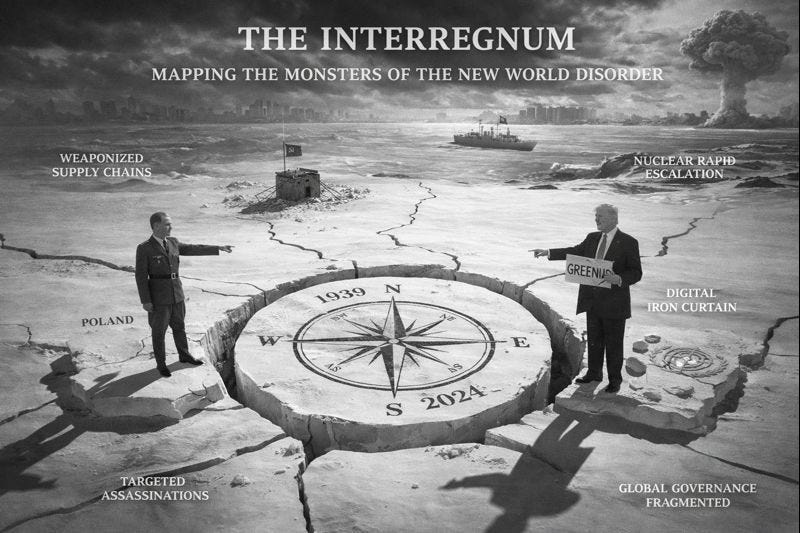
Every international order ends not with a proclamation, but with a loss of belief. The moment arrives quietly, when rules still exist on paper but no longer command obedience, when institutions continue to convene but no longer compel restraint. By 2026, that moment has passed. What governs the world today is not order, nor even chaos, but something more unsettling: an interregnum, a suspended interval in which the old system has died, and no successor has yet been born.
Antonio Gramsci warned that such periods are when “monsters” emerge. He did not mean caricatures or villains, but structural pathologies: distortions of power that thrive precisely because norms have decayed while force remains abundant. The crisis is, therefore, not episodic. It is systemic.
The Arctic “polar pivot” was not the cause of this rupture; it was its signal flare. What it revealed is now unmistakable: the post–World War II rules-based order has fragmented into a set of new world disorders, coexisting, reinforcing, and accelerating one another.
I. The Weaponization of Interdependence
For a generation, globalization was sold as a pacifying force. Interdependence, we were told, would make conflict irrational. That belief now lies in ruins. The very arteries of global commerce, trade, finance, energy, and technology have been converted into instruments of coercion.
Tariffs imposed not on adversaries but on allies; export controls designed not to regulate markets but to cripple competitors; sanctions deployed less as deterrence than as punishment. Supply chains are no longer optimized for efficiency but hardened for confrontation. Inflation, redundancy, and scarcity are no longer policy failures; they are strategic choices.
In this disorder, economic pain is not a byproduct of conflict. It is the method.
II. The Collapse of Sovereignty as a Shared Norm
Sovereignty once functioned as a mutual restraint, a rule respected not out of sentiment, but because violation invited retaliation and instability. That understanding has eroded. What has replaced it is a doctrine of selective inviolability: sovereignty for some, contingency for others.
Targeted killings without a multilateral mandate. Cross-border extractions justified as law enforcement. Jurisdiction stretched to the point of meaninglessness. Each act defended in isolation, each precedent normalized through repetition.
The consequence is not merely legal ambiguity. It is the quiet death of predictability. When power determines legality rather than the reverse, the international system ceases to be a system at all. It becomes a marketplace of force, where security is temporary and allegiance transactional.
III. The Third Nuclear Age
The Cold War’s nuclear order was grim, but it was coherent. The balance of terror imposed discipline, arms control imposed transparency, and fear imposed restraint. That architecture has now collapsed.
What has emerged is a third nuclear era: multipolar, technologically accelerated, and institutionally hollow. Treaties expire without replacement. Communication channels decay. Nuclear weapons are no longer just instruments of deterrence but nodes in integrated systems that include cyber warfare, artificial intelligence, hypersonic delivery, and automated decision-making.
The danger is no longer intentional annihilation. It is inadvertence. A misclassified signal. An algorithm trained on flawed data. A compressed decision window in which human judgment arrives too late.
This is not stability through fear. It is instability through speed.
IV. The Privatization of Global Governance
As formal institutions lose authority, governance has not disappeared; it has relocated. Power is migrating from universal bodies to exclusive arrangements: minilateral clubs, ad hoc coalitions, and informal boards of influence that operate without accountability or representation.
The United Nations persists, but increasingly as a theater rather than a forum. Decisions of consequence are made elsewhere, among those who already possess leverage. The result is a return to a 19th-century logic of concert politics, stripped of its restraint and magnified by modern technology.
For much of the world, this means exclusion without recourse. For the system as a whole, it means legitimacy without consent, an inherently unstable condition.
V. The Rise of Sovereign AI and Digital Feudalism
Technology was once imagined as a universal equalizer. It has become the sharpest divider. Artificial intelligence, data infrastructure, and semiconductor capacity are now treated as sovereign assets, guarded like territory and weaponized like arms.
The world is fragmenting into technological blocs. Standards diverge. Networks bifurcate. States without “sovereign AI” capacity are reduced to digital dependency, their economies optimized for extraction rather than innovation.
This is not merely a tech race. It is the emergence of digital feudalism, where control over computation determines hierarchy, and access replaces citizenship as the basis of power.
The Deeper Pattern
These disorders are not independent. They are symptoms of a single transformation: the replacement of restraint with leverage as the organizing principle of international life.
The postwar order did not survive because it was moral. It survived because it was useful, because it reduced uncertainty, bounded rivalry, and made catastrophe less likely even among adversaries. Its erosion is not the triumph of realism over idealism. It is the abandonment of strategic maturity.
Values alone cannot sustain order. Neither can coercion. Trust, once broken, cannot be sanctioned back into existence.
Restraint as the Final Strategy
The interregnum will not end through nostalgia, nor through dominance. It will end only when restraint is rediscovered, not as a virtue, but as a necessity.
Restraint is not weakness. It is the recognition that power without limits consumes itself. That rules were never gifts from the strong to the weak but guardrails protecting all from escalation, miscalculation, and ruin.
Davos, like all such forums, matters only insofar as it reflects this realization. Dialogue without discipline is noise. Cooperation without constraint is an illusion.
The monsters of the new world disorder are already among us. They were not summoned by malice, but by impatience, by the belief that rules could be bent indefinitely without consequence.
The remaining question is not whether a new order will emerge. It will.
The question is whether it will be shaped by foresight or by the wreckage of what restraint once prevented.

Postscript: “Let me be direct. We are in the midst of a rupture, not a transition.
Over the past two decades, a series of crises in finance, health, energy and geopolitics have laid bare the risks of extreme global integration. But more recently, great powers have begun using economic integration as weapons, tariffs as leverage, financial infrastructure as coercion, supply chains as vulnerabilities to be exploited.”—Canadian Prime Minister Mark Carney’s speech in Davos, Switzerland
Special Address by Mark Carney, Prime Minister of Canada | World Economic Forum Annual Meeting 2026